

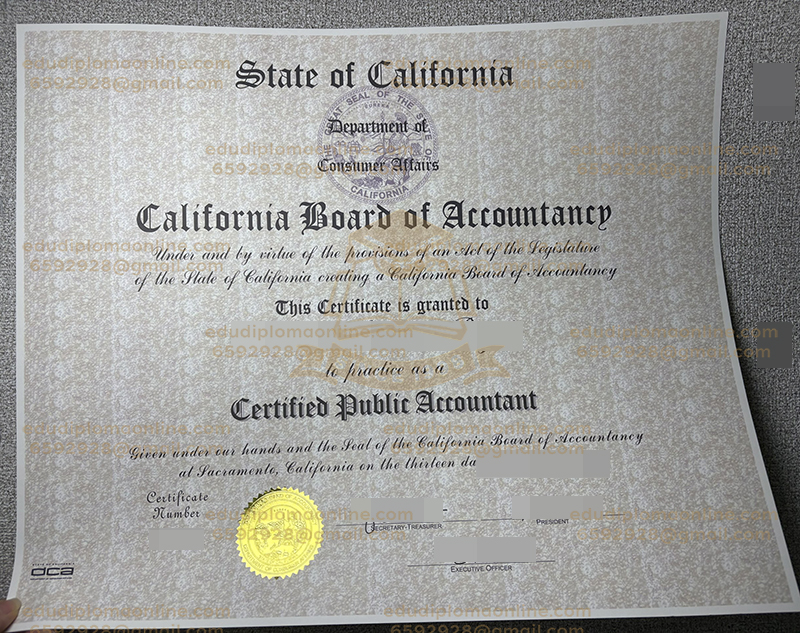
The California CPA (Certified Public Accountant) license is one of the most respected professional credentials in accounting, regulated by the California Board of Accountancy (CBA), a state agency under the Department of Consumer Affairs. California CPA Certificate Design, The CBA protects consumers by ensuring only qualified individuals practice public accountancy in California, setting rigorous standards for education, examination, experience, and ethics since its establishment under the California Accountancy Act.
To become a licensed California CPA, candidates must fulfill comprehensive requirements. Education is key: applicants need a baccalaureate degree or higher (or foreign equivalent evaluated by a CBA-approved service) from an accredited institution, plus a total of 150 semester units (or equivalent quarter units). This includes 24 semester units in accounting subjects (e.g., financial accounting, auditing, taxation), 24 semester units in business-related subjects (e.g., finance, business law, economics), 20 semester units in accounting study, and 10 semester units in ethics (including courses in professional responsibilities or business ethics).

California CPA Certificate Design Showcase | Verified Styles
Next, candidates must pass the Uniform CPA Examination, administered by NASBA and AICPA, consisting of three core sections (Auditing and Attestation, Financial Accounting and Reporting, Regulation) and one discipline section. California allows early entry to the exam with a bachelor’s degree and 24 units each in accounting and business subjects. An ethics exam, such as the AICPA Professional Ethics or a CBA-approved equivalent, is also required.
Experience is essential: applicants need at least 12 months (one year) of general accounting experience under a licensed CPA’s supervision, covering services like attestation, tax, or advisory work. For signing attest reports, additional attest-specific hours may apply.
Once licensed, CPAs must maintain their credential through continuing professional education (typically 80 hours every two years) and adhere to ethical standards. California CPAs enjoy high demand in public accounting firms, industry, government, and consulting, with opportunities for career advancement, higher earnings, and mobility (via practice privileges or reciprocity in many states). The California CPA designation signifies expertise, integrity, and commitment to excellence in a competitive field.